The problems analyzed from the "SAT Wall" are highly representative of the challenging, multi-concept questions often seen on the Digital SAT. The December test is expected to emphasize a mix of complex algebra, integrated geometry, and conceptual data analysis.
Here is a breakdown of the essential topics you must master to succeed.

📈 Advanced Algebra and Functions
These questions often involve manipulating equations to meet a specific condition (like "no solution") or understanding the structure of polynomial expressions.
| Concept | Problem Type | Core Skill |
|---|---|---|
| No Solution/Infinite Solutions | Linear equations with variables for coefficients (e.g., ). | Know the conditions for parallel lines: Slopes must be equal (), but y-intercepts must be different (). |
| Polynomial Identity | Multiplying complex factors like and equating coefficients to a resulting polynomial. | Use the distributive property (FOIL/Box Method) and match the coefficients of corresponding powers of (e.g., , , ) to solve for unknown variables. |
| Sum of Solutions (Quadratics) | Solving equations that simplify to a quadratic, or using the sum/product rule. | For a quadratic , the sum of solutions is . Be able to factor and identify two solutions, even if one is easily found (e.g., a common factor). |
| Literal Equations | Rearranging scientific formulas (like the Law of Gravitation) to isolate a specific variable. | Treat variables as numbers and apply inverse operations (multiplication, division, squaring) to solve for the target variable. |
| Systems of Equations | Solving systems that involve linear and quadratic/non-linear equations. | Utilize the Desmos calculator to graph both equations and quickly find the points of intersection (solutions). This is the fastest method. |
Integrated Geometry & Coordinate Geometry
The DSAT frequently tests geometry concepts by embedding them within algebra or data problems, requiring you to visualize a shape and its properties.
| Concept | Problem Type | Core Skill |
|---|---|---|
| Circles (Standard Form) | Converting the general form of a circle's equation to the standard form . | Complete the Square for both and terms to find the center and the radius . Be prepared for coefficients greater than 1, requiring an initial division. |
| Tangent Lines & Slope | Finding the slope of a line tangent to a circle at a given point. | Understand that the radius to the point of tangency is perpendicular to the tangent line. Use the negative reciprocal of the radius slope for the tangent line's slope. |
| 3D Shapes (Cones) | Finding volume using a right triangle formed by height, radius, and slant height. | Recognize that the height (), radius (), and slant height () form a right triangle. Use to find the missing dimension before applying the volume formula. |
| Inscribed Shapes | Finding dimensions or area of a rectangle inscribed in a circle. | A rectangle's diagonal is the circle's diameter. Use this fact, often combined with the Pythagorean theorem or properties of 30-60-90 triangles, to solve. |
Data Analysis, Probability, and Statistics
Be prepared for questions that test both conceptual understanding (like margin of error) and the ability to work with proportions and weighted averages.
| Concept | Problem Type | Core Skill |
|---|---|---|
| Box Plots | Interpreting and comparing the distributions of two or more data sets. | Know that the line inside the box represents the median. Be able to compare quartiles and medians visually; the mean cannot be determined. |
| Weighted Averages | Finding the concentration/average of a mixture where components have unequal amounts (e.g., different carton numbers of different concentration milk). | Calculate the weighted total: . Do not simply take the arithmetic mean. |
| Conditional Probability | Using proportions/percentages within a sample where subgroups are of unequal size (e.g., "Twice as many people prefer dark chocolate..."). | Assign variables to the different group sizes (e.g., and ) and use them to weight the proportions before calculating the final probability. |
| Margin of Error (Conceptual) | Determining how changes in sample size affect the margin of error (MOE). | Inverse Relationship: A larger sample size results in a smaller margin of error (higher confidence). |
🔥 New Challenge Predicted: Solving Intimidating Systems of Equations
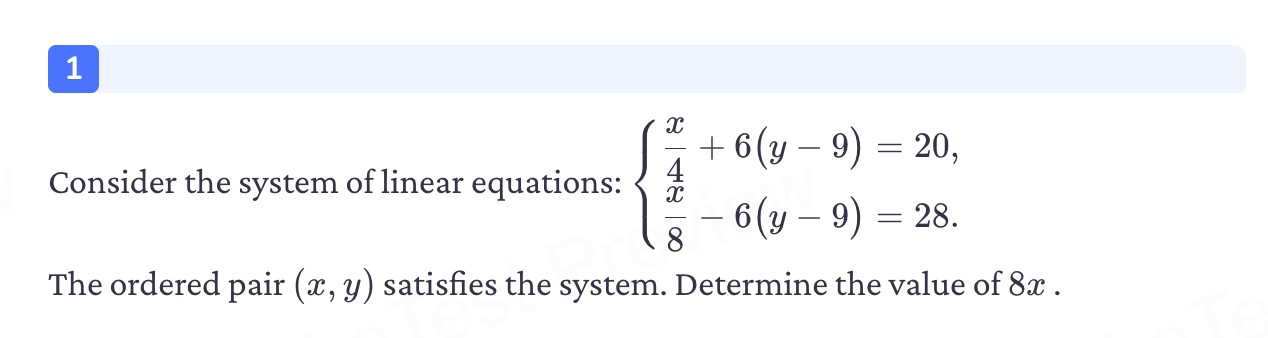
The SAT Insight: Elimination is Your Friend 🤝
Instead of expanding the terms and making the equations messier, notice that the terms in the two equations are opposites: and . This is a massive hint to use the Elimination Method.
Step 1: Eliminate the Y-term by Adding the Equations
Add the left sides and the right sides:
The -terms cancel out perfectly:
Step 2: Solve for
Combine the fractions on the left side:
Now, solve for :
Step 3: Calculate the Target Value ()
The question asks for the value of , not just :
💡 Strategic Takeaway
Many of the "hard" problems (like those involving systems of equations or circle geometry) can be drastically simplified by effectively using the Desmos Calculator. Practice graphing non-standard equations and identifying key features, as this is a core time-saving strategy for the DSAT.
Good luck with your December exam preparation!